Cyprus sits at a crossroads of the eastern Mediterranean, and its icons record almost every turn of its history. The island was a Byzantine province, then a Crusader kingdom under the Lusignans (1192–1489), then a Venetian possession. Throughout these changes its Orthodox painters kept working, absorbing new influences while holding to the Byzantine tradition. The first part of this series introduced the island's earliest images. This second part looks at the Middle Byzantine and Crusader-era icons that have made Cyprus one of the most important places to study Orthodox panel painting.
An island of painted churches
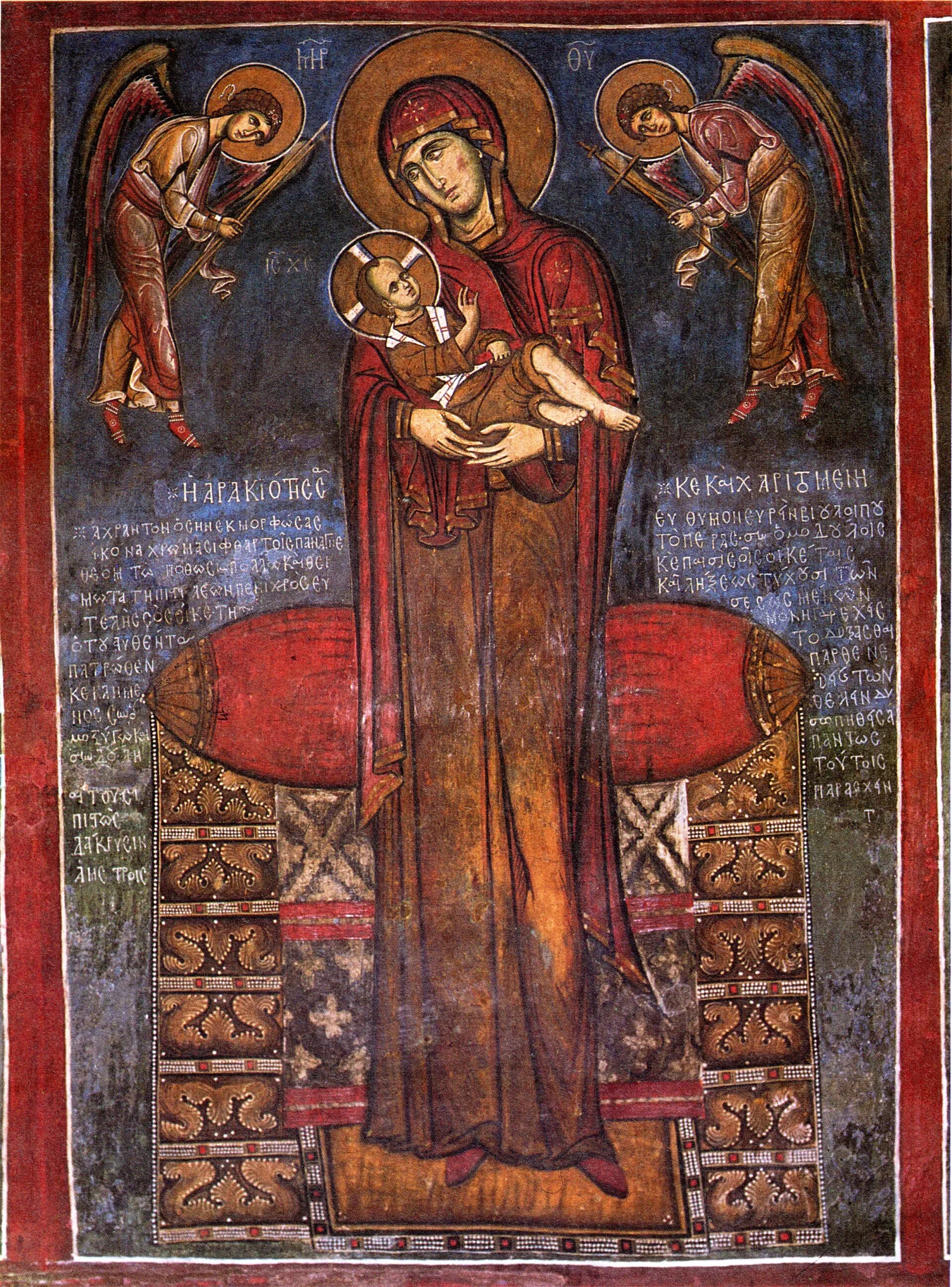
In the Troodos mountains, a series of small churches was built between the eleventh and sixteenth centuries. Many have steep timber roofs added to shed the mountain rain. Ten of them, including Panagia Phorbiotissa at Asinou and Panagia tou Araka at Lagoudera, are listed together by UNESCO as the Painted Churches in the Troodos Region. Their frescoes are well known, but they also matter for panel painting. Several of the island's finest icons were painted for these churches, by the same workshops or under the same patrons.
At Asinou, a dedicatory inscription names the patron Nikephoros Ischyrios and gives a date usually read as 1105/6. At Lagoudera, an inscription dates the painting of the church to 1192, the year the Lusignans arrived. The Lagoudera frescoes are a high point of late Comnenian art. Their figures are elongated, their drapery swirls, and the faces show a refined, almost melancholy feeling. The same style appears in a number of panel icons from the island.
Key works
Christ and the Virgin of Lagoudera. Panel icons of Christ and the Virgin from Lagoudera, now in the collection of the Byzantine Museum in Nicosia, are generally dated to the late twelfth century. Their style has been compared closely with the church's murals. The faces are built up in many thin layers, and the transitions from shadow to light are very soft.
The Panagia of Kykkos. The Holy Royal and Stavropegic Monastery of Kykkos keeps an icon of the Virgin that tradition attributes to the Evangelist Luke. Tradition also says it was given to the hermit Isaiah by the Byzantine emperor Alexios I Komnenos. The icon has long been covered with a silver revetment, and its painted surface is not shown; by custom even its face is kept veiled. Its importance is devotional more than art-historical. Copies of the Kykkiotissa type spread across the Orthodox world.
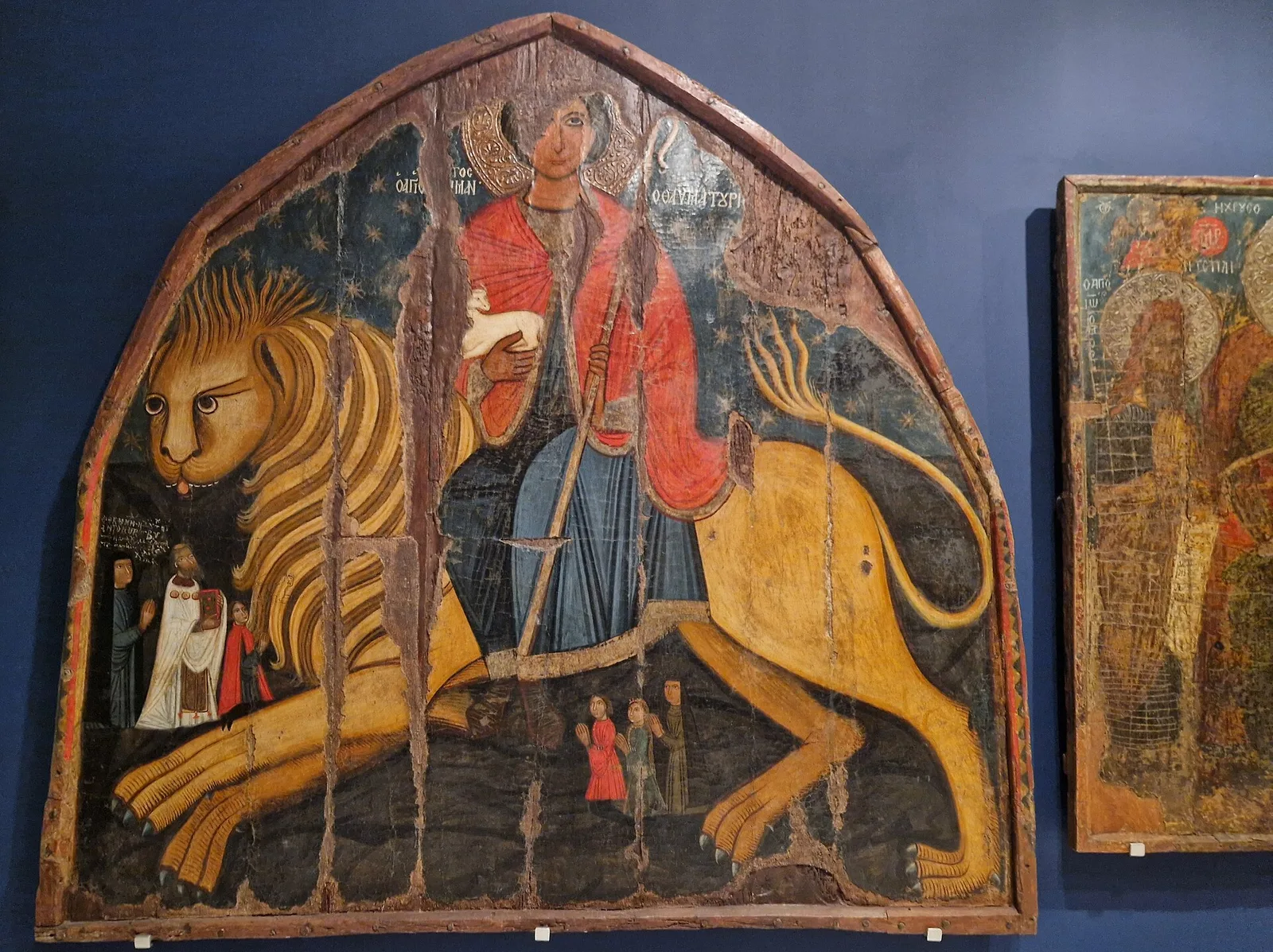
Icons of the "maniera cypria". In the thirteenth century, under Lusignan rule, Cypriot painters developed a distinctive manner that scholars sometimes call the maniera cypria. Typical features include halos and backgrounds of raised, tooled gesso (relief patterns pressed into the gold), certain Western details in dress and ornament, and occasional Latin donors shown in Orthodox compositions. These panels show an Orthodox workshop tradition responding to Crusader patrons without giving up its Byzantine roots.
Iconographic features
Several traits recur in Cypriot icons of this period:
- Relief gesso. Halos, borders and sometimes whole backgrounds are worked in low relief before gilding, catching the candlelight in a way flat gold does not.
- Comnenian elegance. Long-limbed figures, small mouths and finely drawn eyes link the island's art to Constantinople.
- Rich decorative borders. Painted frames with vine scrolls, pseudo-inscriptions and geometric patterns are common.
- Bilateral icons. Some icons are painted on both sides for use in procession, like those known elsewhere in Byzantium.
- Local saints. Alongside the great feasts and the Virgin, painters honoured Cypriot saints such as Barnabas, the island's apostle, and Mamas, both widely venerated.
Loss and return
The island's twentieth-century history threatened many of these works. After 1974, many churches in the north were looted, and icons, frescoes and mosaics appeared on the international art market. The best-known case concerns the sixth-century apse mosaics of the Panagia Kanakaria at Lythrankomi. Fragments were cut from the church and later found in the United States. A court ordered them returned to Cyprus in 1989, and they came back in 1991. Since then other icons and fresco fragments have been recovered through legal action and negotiation, though many remain missing.
Where the works are today
The most important collection is the Byzantine Museum of the Archbishop Makarios III Foundation in Nicosia. It holds icons from roughly the ninth to the nineteenth centuries, along with repatriated mosaics and frescoes. Many icons are still in the churches and monasteries they were painted for, including Kykkos Monastery, which has its own museum, and the Troodos churches. Several local diocesan collections also hold icons. Visitors to the painted churches should check opening arrangements locally, as many are kept locked and opened by a caretaker.
A later part of this series will look at Cypriot icons of the Venetian period, when Italian and Cretan influences reshaped the island's painting.