Few buildings bring us closer to the world of the emperor Justinian than the Basilica of San Vitale in Ravenna. Its mosaics were set in the sixth century, as Byzantine armies were winning back Italy from the Ostrogoths. They are among the best-preserved monumental mosaics to survive from the early Byzantine period. They give a rare glimpse of imperial ceremony, and they mark a key point in the formation of Christian imagery that Orthodox iconography would inherit.
Ravenna between Goths and Byzantines
In the fifth century Ravenna served as a capital of the Western Roman Empire. It later became the seat of the Ostrogothic king Theodoric. After his death, Justinian's general Belisarius took the city in 540, and it became the centre of Byzantine rule in Italy. San Vitale was built across this transition. Construction began under Bishop Ecclesius, around 526–527, while the city was still under Gothic rule. It was financed by a banker known from inscriptions as Julius Argentarius. The church was consecrated by Archbishop Maximian in 547 or 548, by which time Ravenna was a Byzantine city.
The building
San Vitale is an octagon with a central domed space surrounded by an ambulatory and a gallery, and a deep chancel on the east side. The plan is unusual in the West and is often compared with buildings in Constantinople, such as the Church of Saints Sergius and Bacchus. The brick exterior is plain. Inside, the walls are faced with marble, and the chancel and apse are covered with mosaic in glass and gold tesserae.
The mosaic programme
The apse. In the semi-dome, a young, beardless Christ sits on a blue globe, dressed in purple. He holds the scroll with seven seals and offers a crown to St Vitalis, the martyr to whom the church is dedicated. Two archangels flank him. On the far side, Bishop Ecclesius holds a model of the church, presenting the building he founded. The four rivers of Paradise flow from beneath the globe.
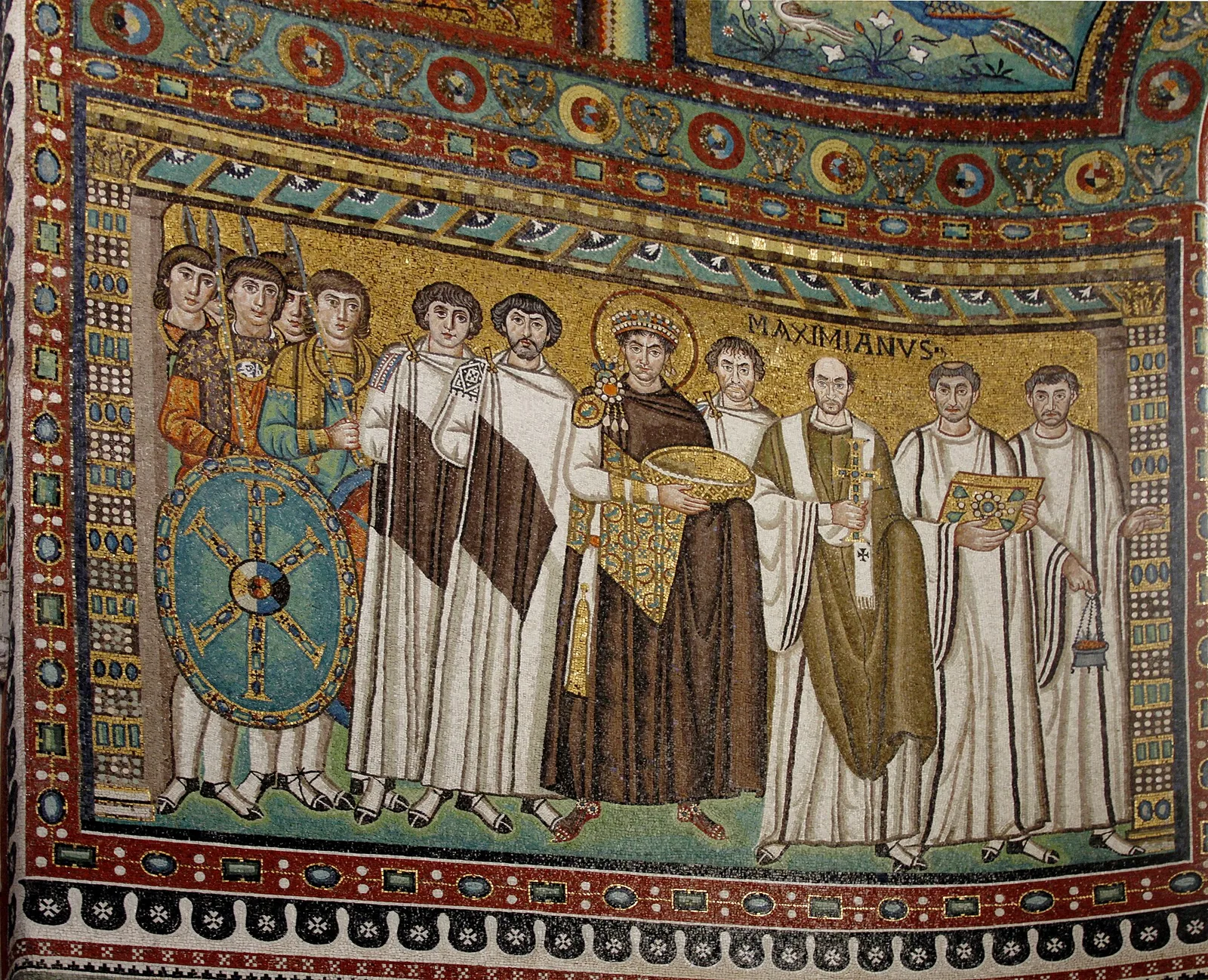
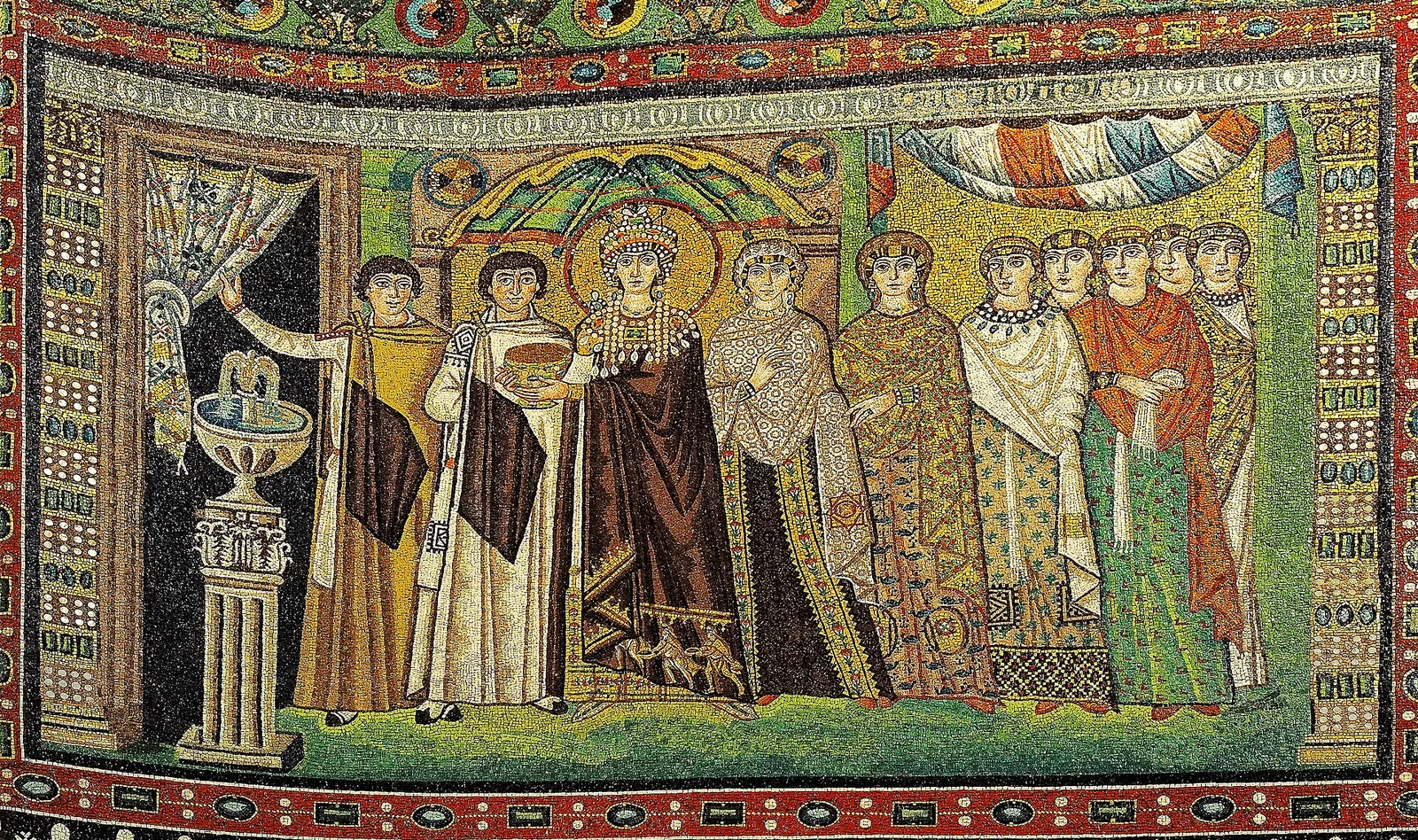
Justinian and Theodora. On the side walls of the apse are the two most famous panels of Byzantine art. On the north side, Justinian, crowned and haloed, carries a golden paten (the dish for the Eucharistic bread). He is surrounded by officials, soldiers and clergy. Beside him stands Archbishop Maximian, identified by the inscription MAXIMIANVS above his head, the only named figure in the scene. Opposite, the empress Theodora carries a jewelled chalice, accompanied by court ladies and attendants. The hem of her purple robe shows the three Magi bringing their gifts. This is a clear parallel to the imperial couple's own offering. There is no evidence that Justinian or Theodora ever visited Ravenna. The panels are a statement of imperial presence and authority, not a record of an actual event.
The chancel. The walls and vault of the chancel carry an Old Testament programme centred on sacrifice and offering. Abel and Melchizedek offer a lamb and bread at an altar. Elsewhere, Abraham entertains three angels and prepares to sacrifice Isaac. Moses appears at the burning bush and on Sinai. The prophets Isaiah and Jeremiah and the four Evangelists with their symbols complete the walls. In the centre of the vault, four angels standing on blue globes support a wreath containing the Lamb of God, set in a dense pattern of vine scrolls, birds and animals.
Significance for Orthodox iconography
The San Vitale mosaics come before the period of Iconoclasm (726–843). The forms of Orthodox iconography were not yet fixed. Even so, much of what the icon tradition would make central is already here:
- The gold ground as a sign of heavenly, timeless space.
- Frontal, still figures facing the viewer, who are engaged in an act of worship and not shown in a dramatic action.
- Typology. Old Testament scenes are chosen because they prefigure the Eucharist celebrated at the altar below.
- The ruler at the altar. The imperial panels express the Byzantine ideal of harmony between Church and empire, which deeply shaped later Orthodox political thought.
The young, beardless Christ of the apse is an early type. In later Byzantine art the bearded Pantocrator became standard. Seeing both side by side in Ravenna, where the bearded Christ appears in other monuments, shows how much variety existed before the tradition settled.
Where the works are today
San Vitale still stands in the historic centre of Ravenna. Its mosaics remain in situ and have been preserved through several restoration campaigns. Since 1996 the church has been part of the UNESCO World Heritage Site Early Christian Monuments of Ravenna, together with the nearby Mausoleum of Galla Placidia, the Neonian and Arian Baptisteries, and Sant'Apollinare Nuovo. Visitors usually buy a combined ticket covering several monuments. The adjacent National Museum of Ravenna, housed in the former monastery of San Vitale, displays related sculpture, ivories and other material.

.jpg)