The Church of the Holy Mother of God Peribleptos (the "All-Seeing" or "Celebrated") stands on the hill of the old town of Ohrid, overlooking the lake. Its frescoes of 1295 are among the earliest securely dated works of the Palaiologan style and among the most powerful. The first part of this series introduced the church and its founder. This second part looks more closely at the painters, the narrative cycles and the later history of the building.
The church and its founder
The Peribleptos was built in 1294/95 by Progon Sgouros, a high-ranking Byzantine official who held the title of megas hetaireiarches. He was related by marriage to the emperor Andronikos II Palaiologos. A dedicatory inscription over the west entrance records the foundation, the founder and the archbishop of Ohrid of the time. The church is a cross-in-square with a single dome, built in alternating courses of brick and stone. Ambulatories and a narthex were added later.
The painters
The Peribleptos is especially important because we know its painters' names. Hidden in the decoration, on the swords and garments of warrior saints and in the folds of clothing, are signatures of Michael and Eutychios. They are usually identified with Michael Astrapas and Eutychios, who went on to work for the Serbian king Stefan Uroš II Milutin in the early fourteenth century. Their later work includes the King's Church at Studenica, the church of St George at Staro Nagoričane and the church of the Virgin Ljeviška at Prizren. The Ohrid frescoes are the earliest known work of this workshop.
Their style is vigorous and dramatic. The figures are heavy and muscular. Their gestures are broad and their faces full of feeling. The compositions are crowded with figures and set against complex architectural backgrounds. Compared with the calm classicism of earlier Byzantine painting, the Peribleptos frescoes seem almost restless. They are an early sign of the new energy that would mark Palaiologan art.
The narrative cycles
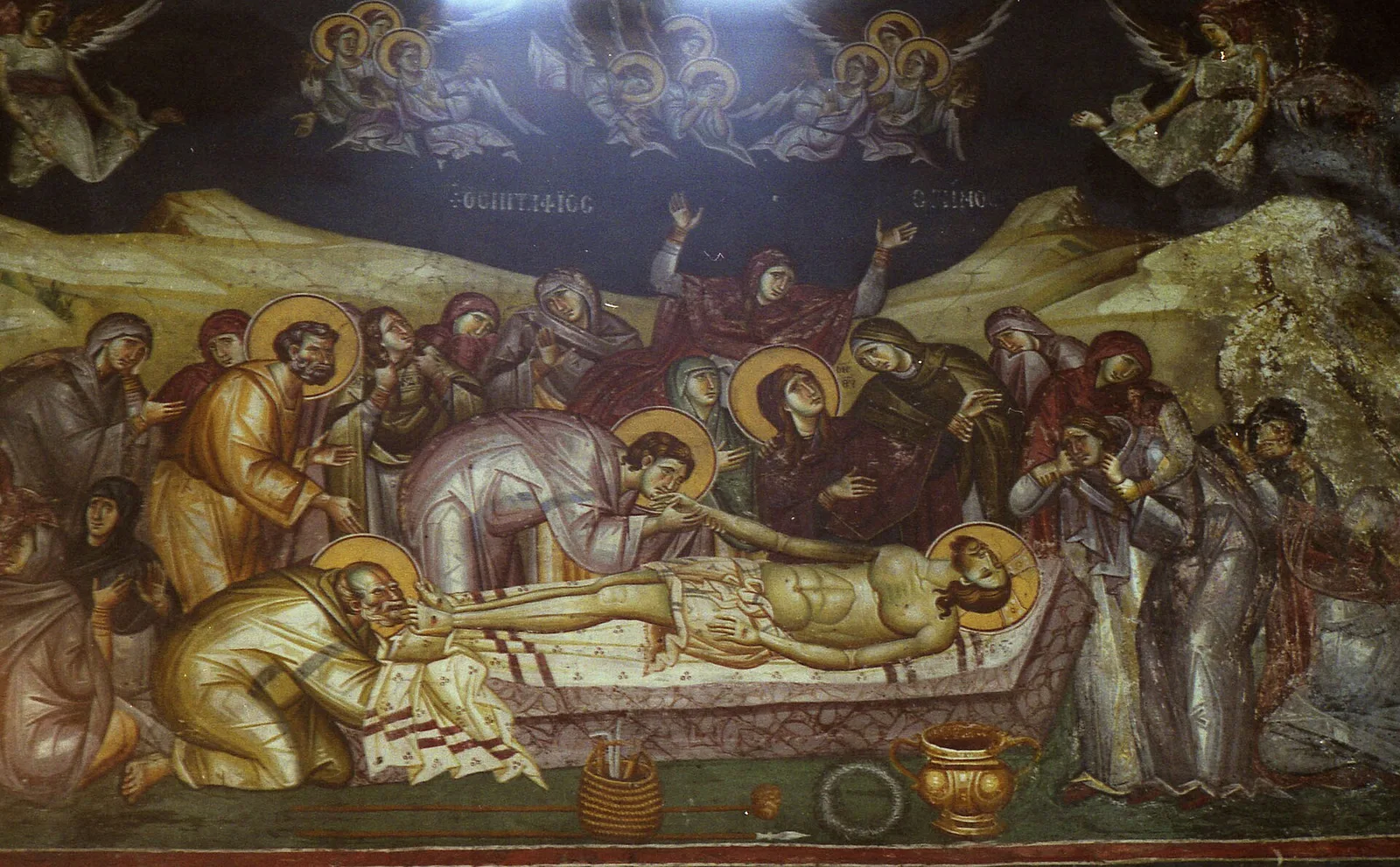
The Passion of Christ. The cycle of Christ's final days is told in great detail. The Betrayal, the Way to Calvary, the Crucifixion and above all the Lamentation (the grief over Christ's dead body) are among the most moving scenes. In the Lamentation, the Virgin presses her face to her Son's, John bends over his hand and the angels above twist in grief. Byzantine art seldom shows emotion so openly.
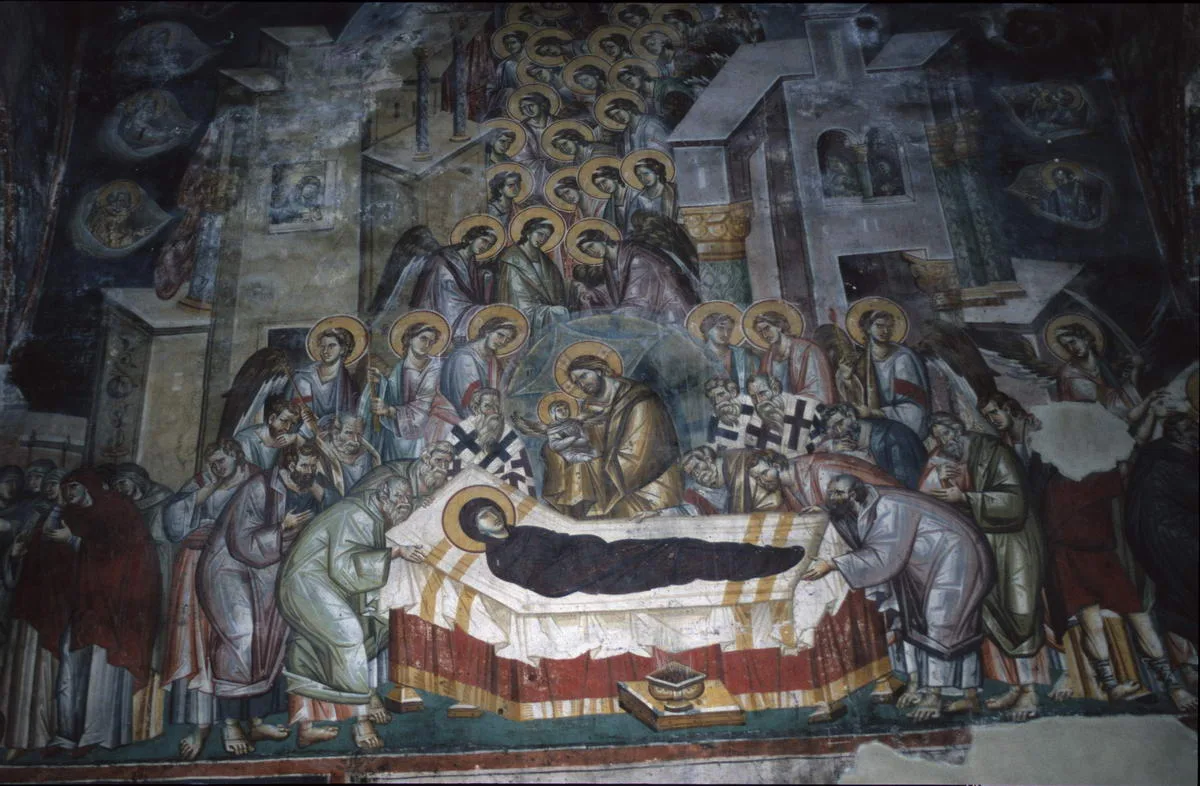
The Life of the Virgin. As befits a church dedicated to the Theotokos, the cycle of the Virgin's life is extensive. It draws on the Protoevangelium of James for scenes such as the meeting of Joachim and Anna, the Nativity of the Virgin and her Presentation in the Temple. The Dormition, on the west wall, is a large and crowded composition of apostles, bishops and mourning women around the Virgin's bier, with Christ receiving her soul.
The Communion of the Apostles. In the apse, below the Virgin, the apostles approach Christ, shown twice behind the altar, to receive the bread and the wine. This liturgical image, placed directly above the altar, ties the painted programme to the Eucharist celebrated below.
Saints and hierarchs. The lower register is lined with full-length saints. Warrior saints wear richly patterned armour, and bishops wear crossed stoles, the polystavria.
Later history
After the Ottoman conquest, the great church of St Panteleimon at Plaošnik, which held the relics of St Clement of Ohrid, was converted into a mosque. The relics were then moved to the Peribleptos. Over time the church became widely known as Sveti Kliment (St Clement). The frescoes were partly overpainted and darkened by centuries of candle smoke. In the twentieth century, conservators cleaned and consolidated them, revealing the strength of the original painting. Conservation of murals of this age is ongoing, and some areas remain damaged.
Where the works are today
The frescoes remain in situ in the church in Ohrid, North Macedonia. Ohrid and its lake form a mixed natural and cultural UNESCO World Heritage Site, inscribed in 1979 and extended in 1980. Next to the church, the Icon Gallery of Ohrid displays one of the finest collections of Byzantine panel icons outside the major museums. They include several fourteenth-century icons associated with the Peribleptos and the city's other churches. A visit to both gives a rare opportunity to see wall painting and panel painting of the same period and place side by side.