Mount Athos, the "Holy Mountain", is the easternmost of the three peninsulas of Chalkidiki in northern Greece. It has been a centre of Orthodox monastic life for more than a thousand years. Twenty sovereign monasteries and many smaller sketes and cells share the peninsula. Between them they hold one of the richest collections of icons in the world. Many are still used for prayer in the churches they were made for. Earlier parts of this series surveyed the monasteries and their founding legends. This fifth part concentrates on the most venerated icons and on the painters whose work defined the Athonite style.
A living treasury
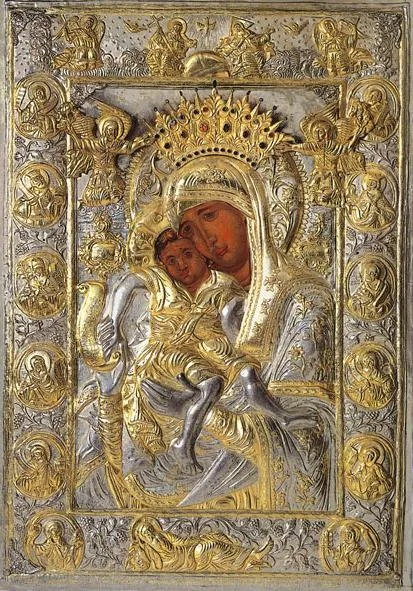
Unlike museum collections, the icons of Athos still belong to communities that pray before them every day. Wonderworking icons of the Virgin are central to Athonite piety. Each monastery has its feast days, processions and traditions. Many of these icons are covered with silver or gilded revetments and dressed with offerings, so their painted surfaces are rarely seen in full. The dates traditionally given to them are often legendary. For many, the painted layers visible today come from later renewals.
The great wonderworking icons
Axion Estin (It Is Truly Meet). Kept in the Protaton, the church of the central administrative town of Karyes, this icon of the Virgin is linked to the tradition that the archangel Gabriel revealed the hymn "It is truly meet" to a monk in a nearby cell. It is the most important icon on the Holy Mountain and is carried in procession on Easter Monday.
Panagia Portaitissa. The "Keeper of the Gate" is kept in a chapel by the entrance of the Monastery of Iviron. Tradition says it came to Athos across the sea, standing upright in a pillar of light. Copies were sent to Russia in the seventeenth century, and the type, known there as the Iverskaya icon, became one of the most beloved in Russian devotion.
Panagia Trikheroussa (Three-Handed). Kept at the Serbian monastery of Hilandar, this icon is traditionally connected with St John of Damascus. A silver hand was added in thanksgiving for the healing of his severed hand. It is traditionally regarded as the abbess of the monastery, and its place in the church is the abbot's stall.
Other icons. Vatopedi keeps several highly venerated icons of the Virgin, including the Vimatarissa and the Paramythia ("Consolation"). The Great Lavra keeps the icon called Koukouzelissa, associated with St John Koukouzelis, the famous chanter.
Painters and the Athonite style
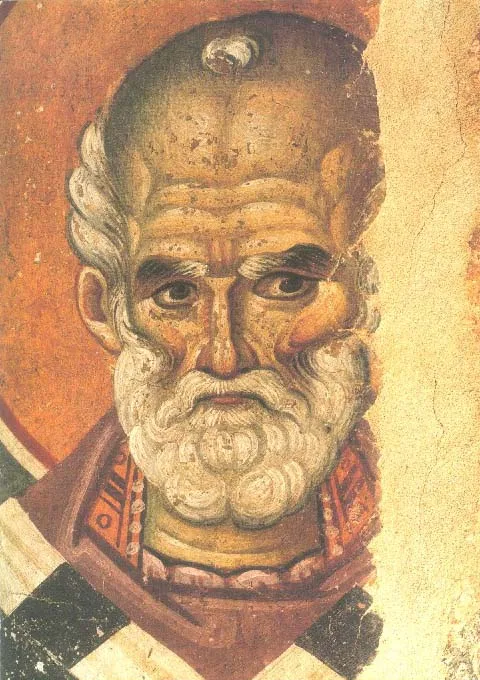
The Protaton frescoes. Around 1290, the Protaton was decorated with a fresco cycle that tradition attributes to Manuel Panselinos, the legendary master of the "Macedonian school". Little is known about him for certain, and his authorship is a matter of tradition, not documents. Still, the Protaton paintings, with their sculptural figures, deep folds of drapery and grave, expressive faces, are among the most admired works of the Palaiologan period.
Theophanes the Cretan. In the sixteenth century, painters trained in Venetian Crete brought a new style to Athos. Theophanes Strelitzas (Bathas), known as Theophanes the Cretan, signed and dated the paintings of the katholikon of the Great Lavra in 1535. With his sons, he also painted the katholikon of Stavronikita (1546). He produced icons for these monasteries as well. The Cretan manner combined Palaiologan models with fine draughtsmanship, dark flesh tones with bright highlights, and great clarity of composition. It shaped Athonite painting for centuries.
Frangos Katelanos. Another painter working in the Cretan-Palaiologan tradition, Katelanos is associated with the chapel of St Nicholas at the Great Lavra, painted in 1560.
Dionysios of Fourna. In the early eighteenth century, the hieromonk Dionysios of Fourna compiled the Hermeneia, a painter's manual. It gave recipes for preparing materials and detailed instructions for the iconography of saints and feasts, and it consciously looked back to Panselinos as a model. It remained an important guide for Orthodox painters well into modern times.
Iconographic features
- Monastic austerity. Ascetic saints, hermits and monastic fathers are given special prominence.
- Marian focus. The Holy Mountain is dedicated to the Theotokos, and icons of the Virgin dominate its devotional life.
- Continuity. Athonite painters deliberately copy and renew older models, so styles persist for long periods.
- Portable mosaic icons. A few monasteries keep rare miniature mosaic icons from the Byzantine period, made with tiny tesserae of stone, glass and gold.
Where the works are today
Almost all Athonite icons remain on the Holy Mountain. Entry is restricted: only men may visit, and they need a permit (diamonitirion). Athos has been a UNESCO World Heritage Site since 1988. Major exhibitions have allowed a wider public to see some of these works, most notably Treasures of Mount Athos in Thessaloniki in 1997. The Museum of Byzantine Culture in Thessaloniki and the Byzantine and Christian Museum in Athens hold related Byzantine and post-Byzantine icons for those unable to visit Athos itself.