If Novgorod represents the beginnings of Russian church painting, Yaroslavl represents one of its last great flowerings before Peter the Great's reforms. In the seventeenth century this Volga city grew rich on river trade. Its merchants built brick churches of remarkable ambition and paid teams of painters to cover their interiors from floor to vault with colour. The result is one of the most complete groups of late medieval Russian murals anywhere.
A merchants' city
Yaroslavl was founded, by tradition, by Prince Yaroslav the Wise in the early eleventh century. A fire in 1658 destroyed much of the city. The rebuilding that followed coincided with a boom in commerce on the Volga, which linked Moscow and the north with Astrakhan and the Persian trade. Wealthy families such as the Skripins (fur and trade merchants), the Nadeins and the Gurevs expressed their piety and status by building parish churches. Unlike many earlier Russian churches, these were built and decorated by laypeople, and the paintings reflect their tastes: lively storytelling, everyday detail and great abundance.
The historic centre of Yaroslavl was inscribed on the UNESCO World Heritage List in 2005, in part for this exceptional group of churches.
The great ensembles
The Church of Elijah the Prophet. Built in 1647–1650 at the expense of the merchants Vonifaty and Ioanniky Skripin, this church stands at the heart of the old city. Its murals were painted in 1680–1681 by an artel (a cooperative team) of painters from Kostroma and Yaroslavl. The team is usually said to have been led by Gury Nikitin and Sila Savin. The cycles include the Life of Elijah and his disciple Elisha, the Acts of the Apostles and many Gospel scenes, all told in long horizontal bands. The building and its paintings are now part of the Yaroslavl museum-reserve and are among the best preserved of the period.
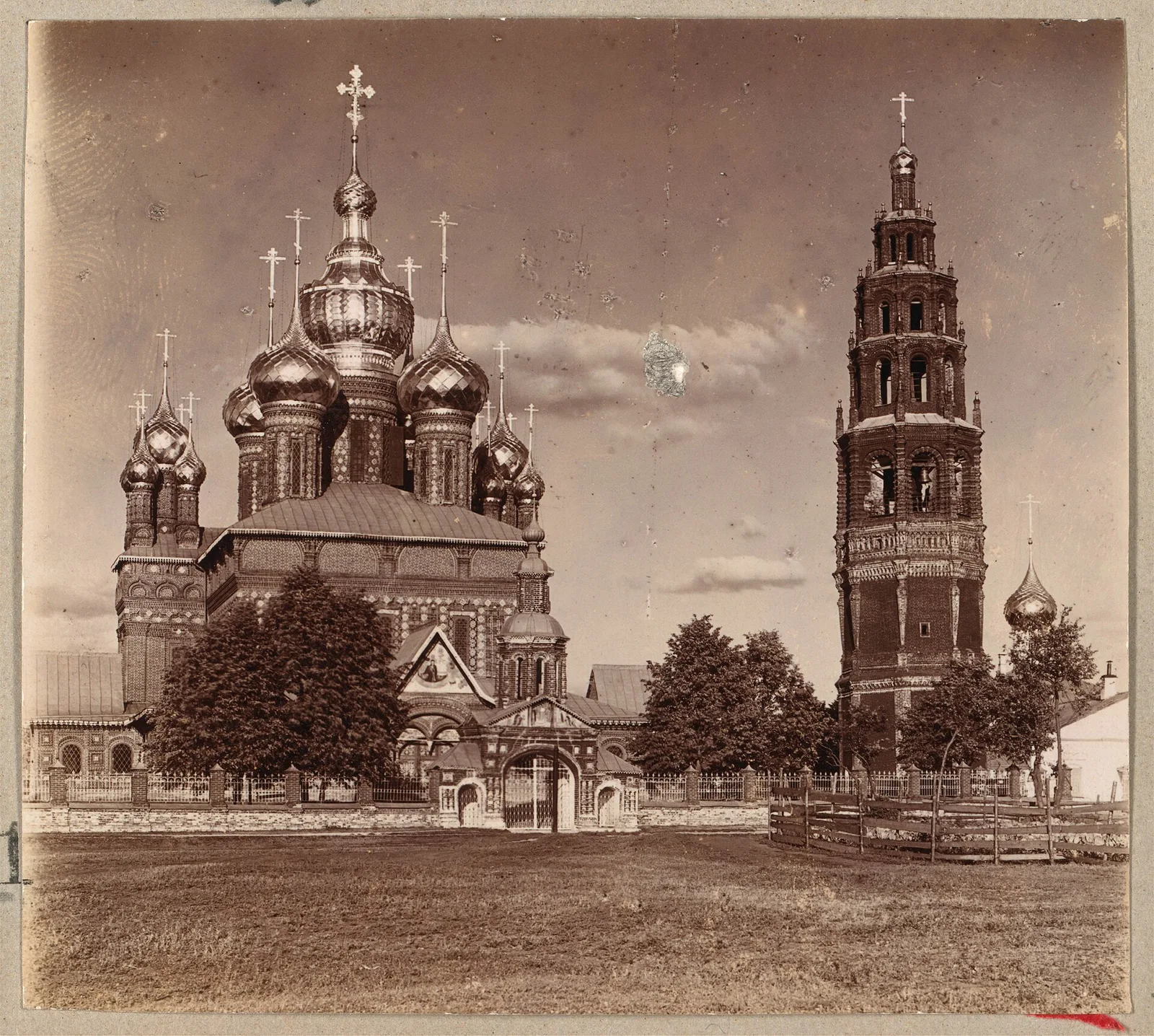
The Church of St John the Baptist at Tolchkovo. Built between 1671 and 1687 in a district of leather workers, this fifteen-domed church is one of the largest of its time. Its murals, painted around 1694–1695, are attributed to an artel led by Dmitry Grigoriev (Plekhanov). They are known for their huge number of scenes and their decorative richness. The building still has its wonderful tiled exterior decoration.
The Church of St Nicholas Nadein. Built in the 1620s for the merchant Nadei Sveteshnikov, this is one of the earliest of the merchant churches. Its murals of 1640–1641 come from an earlier generation of painters and show the style before the full flourishing of the later decades.
The Church of St John Chrysostom at Korovniki. Part of a picturesque riverside ensemble with a tall bell tower, this church is better known today for its architecture and tiles than for its interior painting.
The use of Western engravings
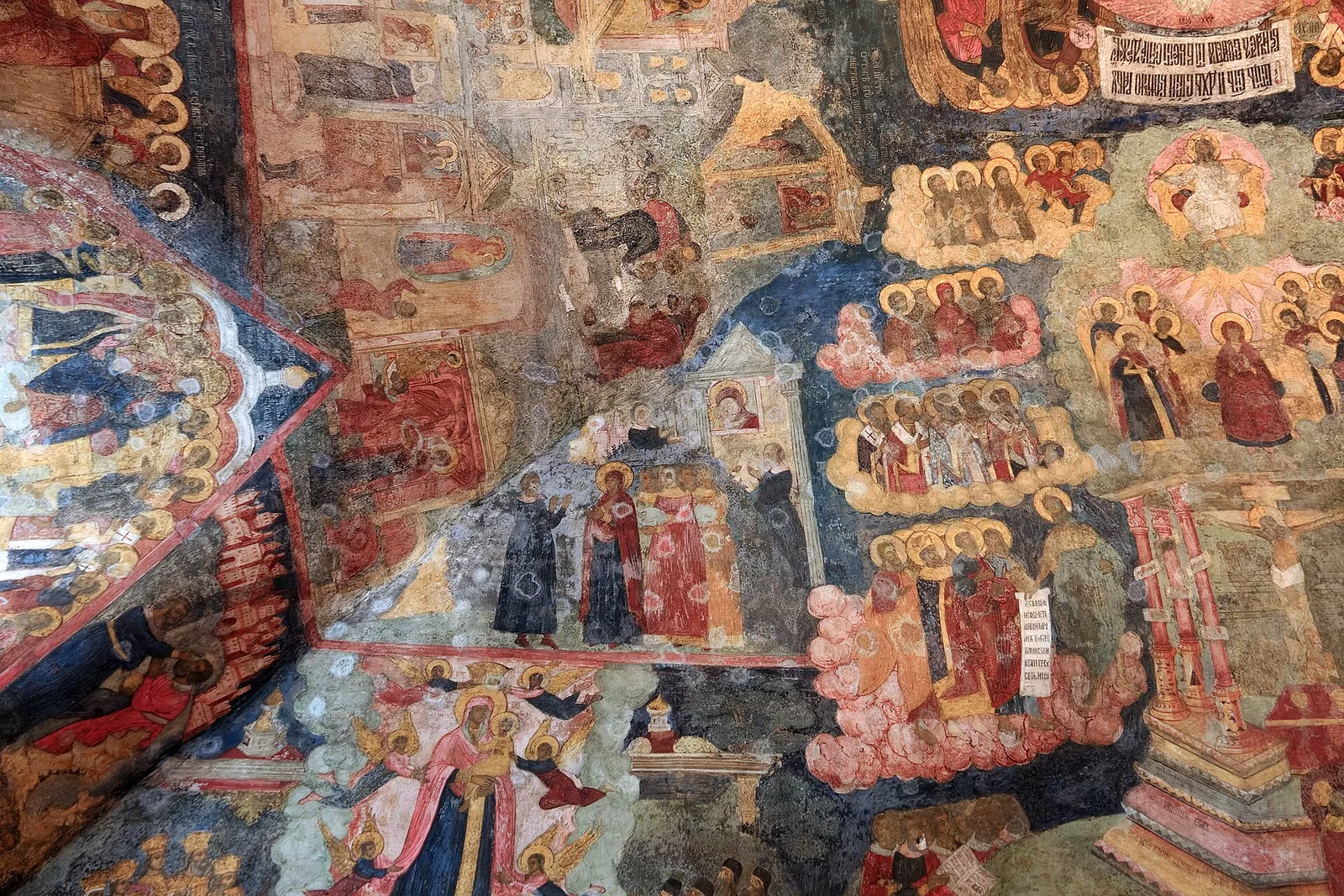
The Yaroslavl painters are famous among art historians for the use they made of imported Western prints. Their main source was the illustrated Bible published in Amsterdam by Nicolaes Visscher, often known as the Piscator Bible. Its engravings were based on Dutch and Flemish models, and many compositions in Yaroslavl can be traced to them. The painters did not simply copy. They translated the engraved scenes into the flat colour, reverse perspective and conventional figure types of Russian church art. They often changed the costumes and setting, and they set the result within long Orthodox narrative cycles.
The result is a hybrid. Biblical scenes contain ploughmen, reapers, ships, horses and city crowds that seem to have stepped out of seventeenth-century Russian life. Yet the whole is still governed by the logic of the Orthodox church interior. The Pantocrator is in the dome, the Virgin in the apse and the Last Judgement on the west wall.
Iconographic features
- Narrative density. Walls are divided into many registers, each crowded with episodes. They read almost like an illustrated chronicle.
- Bright colour. Clear blues, warm reds, greens and golden ochres dominate, often against light grounds.
- Landscape and architecture. Hills, trees and fantastic buildings fill the backgrounds and give a sense of space.
- Ornamental unity. Painted floral friezes and borders bind the many scenes into a single decorative whole.
- Moral and everyday detail. Parables and Old Testament stories are told with homely details that would have spoken directly to merchant patrons.
Where the works are today
Unlike panel icons, murals stay where they were painted. The ensembles of the Church of Elijah the Prophet, St John the Baptist at Tolchkovo and St Nicholas Nadein can be seen in situ in Yaroslavl. Some churches are used for worship and others are managed by the Yaroslavl Museum-Reserve. Opening times and access vary by season, and conservation work periodically closes parts of the interiors. The museum-reserve and the Yaroslavl Art Museum also hold icons and church furnishings from the same workshops, which give a fuller picture of the city's seventeenth-century art.