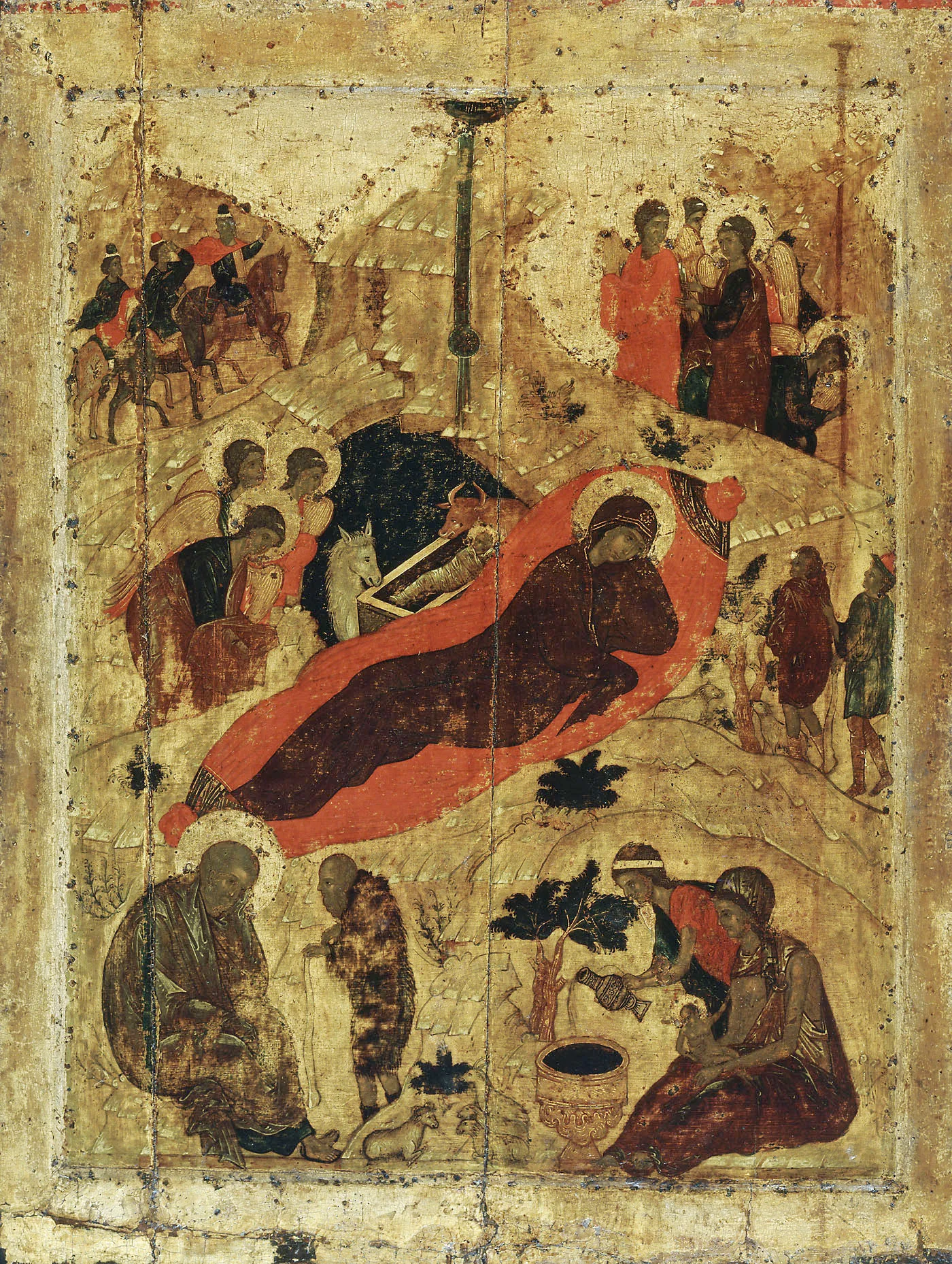
The Nativity of Christ is one of the twelve Great Feasts of the Orthodox Church, and its icon is among the most familiar images in Russian church art. It appears in the festal tier of almost every iconostasis, on single panels for the feast, and in the wall paintings of countless churches. Its main elements were fixed in Byzantium long before Rus' received Christianity. Russian painters kept them faithfully, but each school gave the image its own colour, rhythm and mood.
Sources of the image
The Nativity icon draws on more than one text. The Gospels of Luke and Matthew supply the manger, the angels, the shepherds and the Magi with their star. The Protoevangelium of James, an apocryphal text of the second century, adds the cave, the midwives and Joseph's doubts. The hymns of the feast shape the meaning of the whole: Christ is born in a cave so that he may later descend into the tomb, and creation brings its gifts to its Creator. The icon does not illustrate one moment. It gathers the whole story into one picture, arranged around its centre.
The elements of the composition
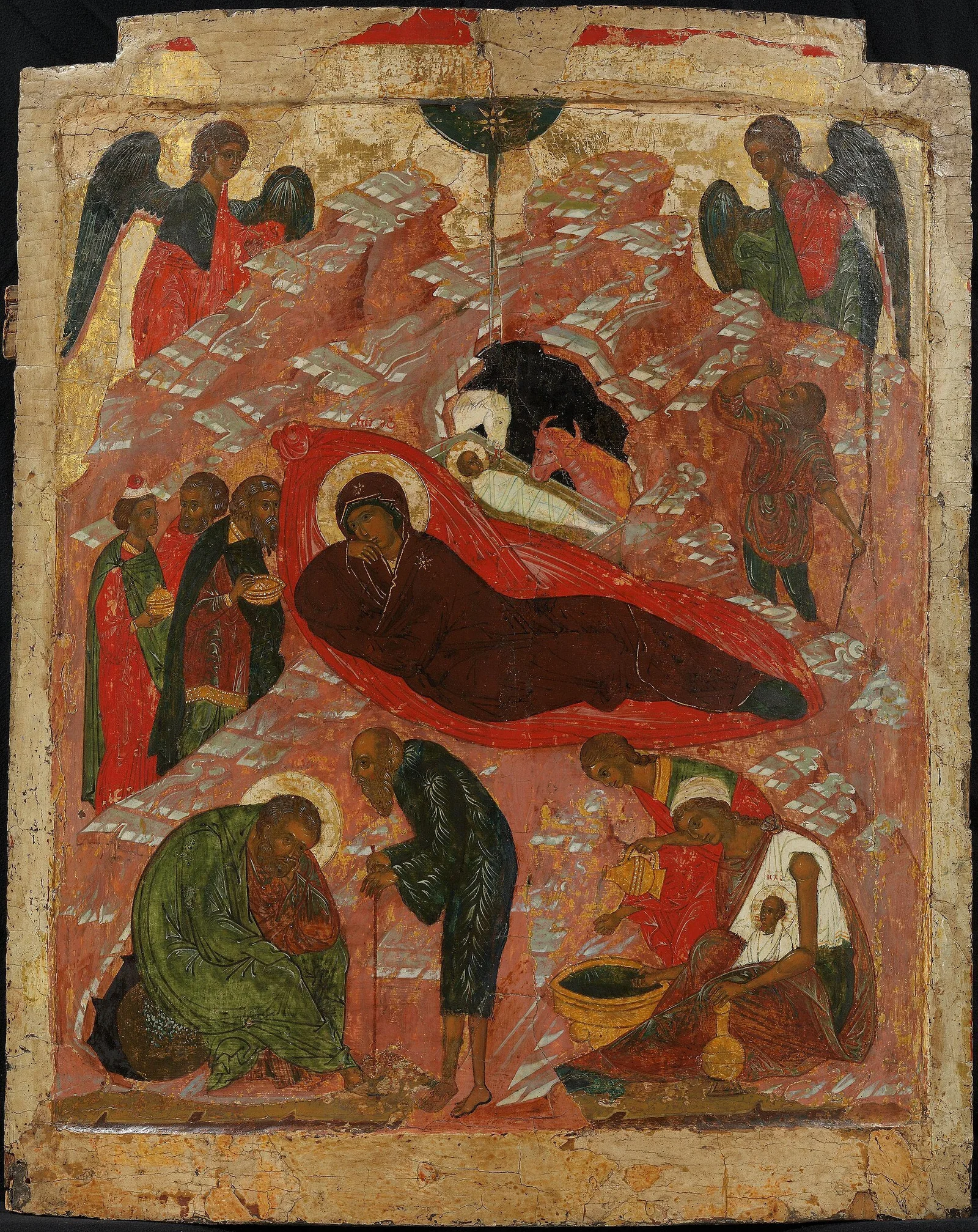
The mountain and the cave. The scene is set in a rocky landscape of stepped, fan-like hills. At its centre opens a dark cave. The darkness stands for the world into which the Light is born, and its shape anticipates the tomb of Easter.
The Virgin. The Mother of God lies or half-reclines on a large red or crimson mattress, the largest figure in the composition. She is usually turned slightly away from the Child, looking out or downward in quiet thought. Her pose recalls the late antique image of a mother after childbirth, and it stresses that Christ truly took flesh.
The Child in the manger. Christ lies tightly swaddled in a manger that is often drawn as a stone box. Its form deliberately resembles a sarcophagus or an altar, linking the birth with the death and with the Eucharist.
The ox and the ass. Two animals lean over the manger, breathing warmth on the Child. They are not mentioned in the Gospels. Their presence goes back to Isaiah 1:3: "The ox knoweth his owner, and the ass his master's crib."
The star and the angels. At the top, a segment of sky sends down a single ray, often ending in a star, onto the cave. Angels gather on the hills. Some look up in praise, while one bends towards the shepherds to bring the good news.
The Magi and the shepherds. The Magi, shown as three men of different ages, approach on horseback or on foot, carrying gifts. Shepherds with their flocks listen to the angel. Sometimes a young shepherd plays a pipe.
Joseph and the tempter. In the lower corner, Joseph sits apart, head in hand, troubled. Before him stands an old man in a rough cloak, often leaning on a staff. Later Orthodox commentary usually identifies him as the tempter, sowing doubt about the virgin birth. Some older interpretations see him simply as a shepherd. The figure gives the scene a note of human struggle at the edge of the miracle.
The washing of the Child. In the opposite corner, two women prepare a bath. They are the midwives of the apocryphal account, often named Salome and Zelomi. One pours water while the other holds the Child. The scene stresses again that Christ was a real infant.
The Novgorod treatment
Novgorod icons of the fifteenth and sixteenth centuries are recognisable by their bright cinnabar red, clear white highlights on the rocky hills and strong, simple silhouettes. The Virgin's red mattress often dominates the centre, and the figures are set against light grounds, which makes the composition easy to read from a distance. Narrative details are reduced to essentials. A Nativity icon now in the National Museum of Art, Architecture and Design in Oslo, assigned to the Novgorod school, shows these features clearly. Another well-known example is the Nativity from the church of St Nicholas in Gostinopolye, usually dated to around 1475 and now in the Intesa Sanpaolo collection in Italy.
Moscow and the circle of Rublev
The Annunciation Cathedral in the Moscow Kremlin preserves one of the most important festal tiers of early Russian painting. According to the chronicles, the cathedral was painted in 1405 by Theophanes the Greek, Prokhor of Gorodets and Andrei Rublev. Several icons of the festal row, including the Nativity, are traditionally attributed to Rublev, although scholars continue to debate how the work was divided between the three masters. The Nativity is calm and luminous. The hills are bathed in pale light, the figures are slender and the colour is gentle. The Virgin rests peacefully, and the whole scene seems to breathe.
A similar spirit is found in the festal icons of the iconostasis of the Trinity Cathedral of the Trinity-Sergius Lavra (1420s). These are associated with the workshop of Rublev and Daniil Chorny, though individual attributions are uncertain. Later Moscow painting, especially that of the Stroganov workshops around 1600, turned the Nativity into a miniature world. It added more episodes, finer drawing and richer landscape, but kept the same structure.
Where the works are today
The festal icons of the Annunciation Cathedral remain in the cathedral, now part of the Moscow Kremlin Museums. The Trinity Cathedral icons are still at the Trinity-Sergius Lavra in Sergiev Posad. Novgorod-school Nativity icons can be seen in the Novgorod State United Museum-Reserve, the State Russian Museum in St Petersburg and the State Tretyakov Gallery in Moscow. Others are in collections abroad, including the National Museum in Oslo and the Intesa Sanpaolo collection in Italy.
.jpg)
