Ornament is the quietest part of a church interior, and often the most telling. It covers borders, vaults, liturgical textiles and the margins of manuscripts, and it travels easily between cultures in a way figurative images often do not. The ornamental tradition of the Kazan Tatars is a good example. It grew on the middle Volga from roots in Volga Bulgaria and the wider Islamic world. After the Russian conquest of Kazan in 1552, it became part of the visual environment of Muscovite Russia. This article looks at the main features of Tatar ornament and at the debated question of how far it touched Russian church decoration.
Origins on the middle Volga
The ancestors of the Kazan Tatars include the population of Volga Bulgaria, a state that adopted Islam in the early tenth century and traded with Central Asia, Persia and the Islamic world. After the Mongol invasions of the thirteenth century the region became part of the Golden Horde. In the fifteenth century the Khanate of Kazan emerged as an independent state. Its art drew on all these layers: Bulgar stone carving, the floral language of Persian and Central Asian decoration, and the craft traditions of the Volga towns.
Because Islamic tradition generally avoided figurative images in religious settings, ornament became the main artistic language. It covered tombstones, wooden houses, leatherwork, jewellery, embroidery and calligraphy.
Principal motifs
Several motifs are characteristic of Kazan Tatar decorative art:
- The tulip and other flowers. Stylised tulips, together with carnations, poppy-like blossoms and leafy sprays, are the most widely recognised Tatar motifs. They are often arranged in symmetrical bouquets growing from a single stem or vase.
- The scrolling vine. Continuous tendrils with leaves and buds fill borders and backgrounds, much as in Persian and Ottoman art.
- Geometric interlace. Stars, rosettes and interwoven bands appear especially in woodwork and stone carving.
- Calligraphy. Arabic-script inscriptions, from epitaphs on gravestones to the later shamail (devotional pictures painted on glass or paper), were themselves treated as ornament.
Materials and techniques
Leather mosaic. The soft boots called ichigi and other footwear were made from pieces of coloured leather sewn together into floral patterns. This technique is still practised in Kazan today and is strongly associated with Tatar identity.
Embroidery. Tambour embroidery in gold thread and coloured silks decorated skullcaps (tubeteika), caps (kalfak), towels and covers, using the same floral vocabulary.
Jewellery. Kazan goldsmiths worked in filigree and granulation and often added coloured stones. Their pieces show the scrolling patterns found in other media.
Carved stone. Gravestones from the Bulgar and Kazan periods carry carved epitaphs framed by ornamental borders. They are among the oldest surviving dated examples of the tradition.
Contact with Russian church decoration
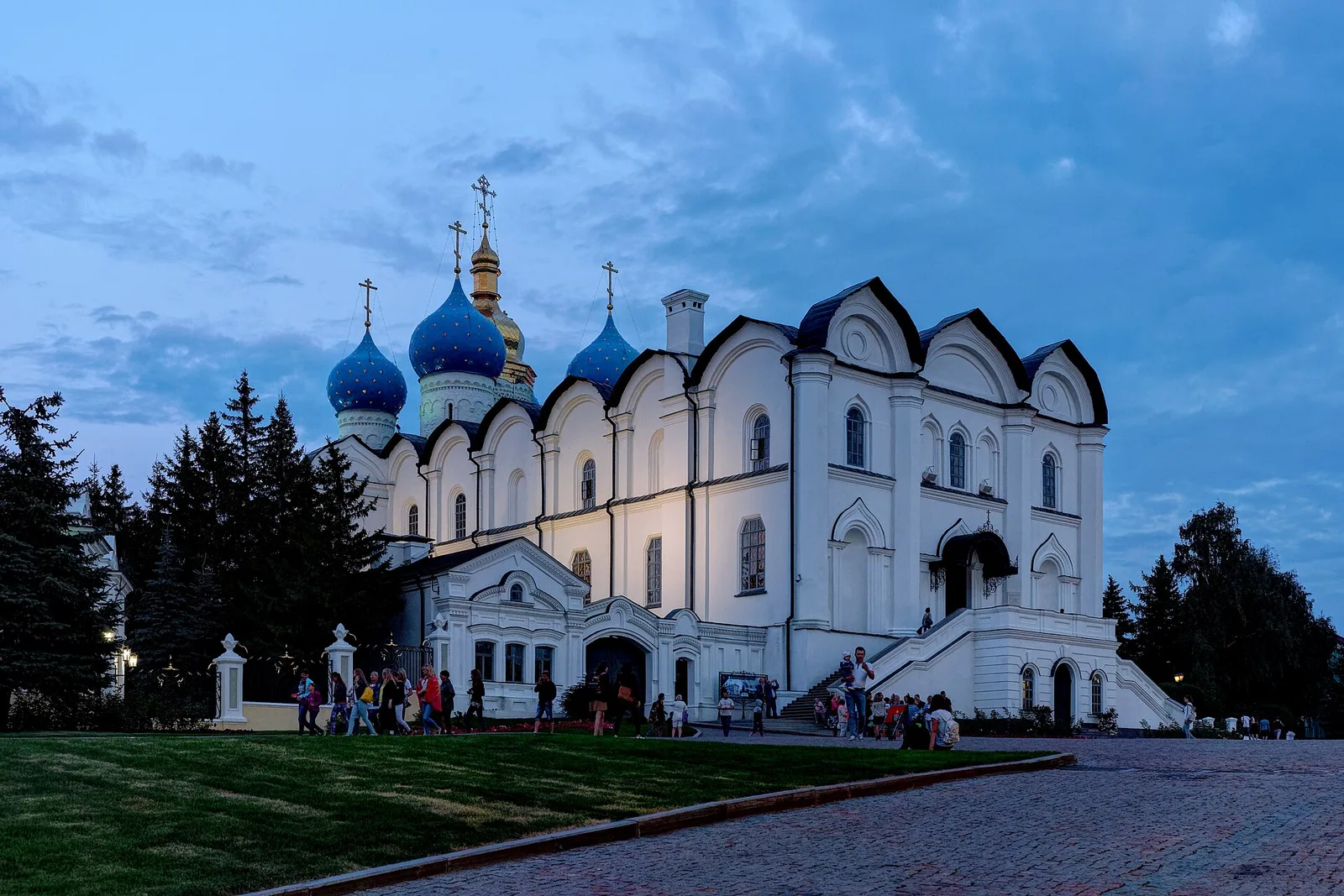
After 1552, Kazan became a Russian city. Ivan IV's builders put up Orthodox churches in the Kazan Kremlin, most notably the Cathedral of the Annunciation (1561–1562), traditionally associated with Pskov masters Postnik Yakovlev and Ivan Shiryai. Over the following century, Tatar craftsmen are recorded working in Moscow, and some were employed in the workshops serving the court.
Art historians have long noticed how important Eastern-looking floral ornament became in Muscovite decorative art of the sixteenth and seventeenth centuries. It appears in embroidered church textiles, carved iconostases, enamelled and engraved metalwork, and the painted borders of churches like those of Yaroslavl. The "grass ornament" (travy) of Russian painting, with its curling stems, fantastic blossoms and symmetrical bouquets, has clear relatives in Persian, Ottoman and Tatar work.
Some caution is needed here. Muscovy was in contact with many Eastern traditions at once: through trade with Persia and the Ottoman Empire, through imported textiles and metalwork, and through Tatar subjects and craftsmen. It is rarely possible to say that a particular Russian motif came specifically from Kazan rather than from this broader Eastern world. What we can say is that Tatar ornament was one of the sources in the shared visual language of Muscovite decoration, and that the meeting of Orthodox and Islamic craft in the Volga region was creative.
Where the works are today
Tatar ornament can be studied in the National Museum of the Republic of Tatarstan in Kazan, which holds textiles, jewellery, leatherwork and epigraphic stones. The Russian Museum of Ethnography in St Petersburg also has significant collections of Tatar costume and crafts. The Kazan Kremlin, a UNESCO World Heritage Site since 2000, preserves the Annunciation Cathedral next to the Kul Sharif mosque (rebuilt in 2005). Few places show more clearly how the two traditions grew up side by side. Leather-mosaic and embroidery workshops in Kazan continue the craft today.