In the twelfth century, Novgorod was one of the richest cities in Rus'. It sat on the Volkhov River, on the trade route linking the Baltic to the Volga and, further off, Byzantium. Its merchants and boyars dealt with the Hanseatic towns, and its archbishops held real authority. Over time the townspeople's assembly, the veche, won the right to invite and dismiss their princes. This wealth and independence made Novgorod a major patron of church art. A small group of panel icons survives from this period. They are among the oldest Russian icons we have, and the surest guide to how Byzantine painting took root in the north.
A city built around Holy Wisdom
The religious centre of Novgorod was the Cathedral of St Sophia, built in about 1045–1050 under Prince Vladimir Yaroslavich. Its name and dedication followed Hagia Sophia in Constantinople and St Sophia in Kiev. The old saying "Where St Sophia is, there is Novgorod" shows how closely the city tied itself to the cathedral. The twelfth century brought a wave of new building. Prince Mstislav and his successors founded the Cathedral of St Nicholas at Yaroslav's Court (1113) and the Cathedral of the Nativity of the Virgin at the Antoniev Monastery (1117). They also built the Cathedral of St George at the Yuriev Monastery, begun in 1119. Each church needed icons for its iconostasis and its walls, and some of those panels survived the centuries in later churches, sacristies and finally museums.
The surviving panels
Several icons are traditionally associated with twelfth-century Novgorod. Specialists still debate exactly where and when some of them were painted.
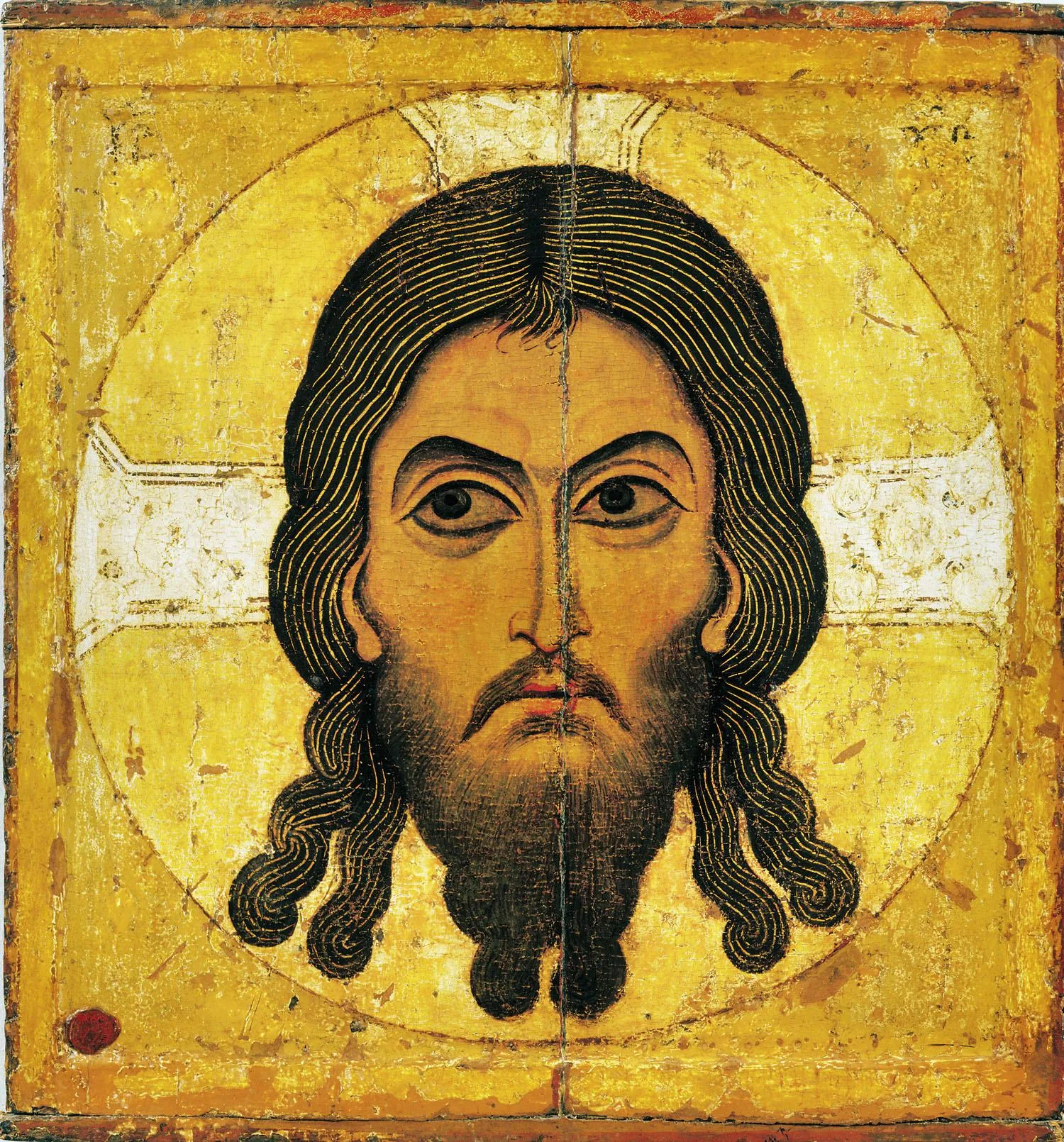
The Holy Face (Saviour Not Made by Hands). This large double-sided icon is now in the State Tretyakov Gallery in Moscow and is usually dated to the second half of the twelfth century. One side shows the face of Christ on a gold ground, with no shoulders or cloth. It is strictly symmetrical: wide-open eyes, a calm forehead and long locks of hair framing the face. The reverse shows angels venerating the Cross, the Crown of Thorns and the instruments of the Passion. The icon was probably carried in procession, so both sides were meant to be seen.
St George. A half-length St George, traditionally linked with the Yuriev Monastery, is held in the Dormition Cathedral of the Moscow Kremlin. It is often dated to the second quarter of the twelfth century. Later repainting changed it, but restorers have recovered much of the original. The warrior saint holds a spear and a sword. His face is solemn and youthful, more an image of a martyr than of a soldier.
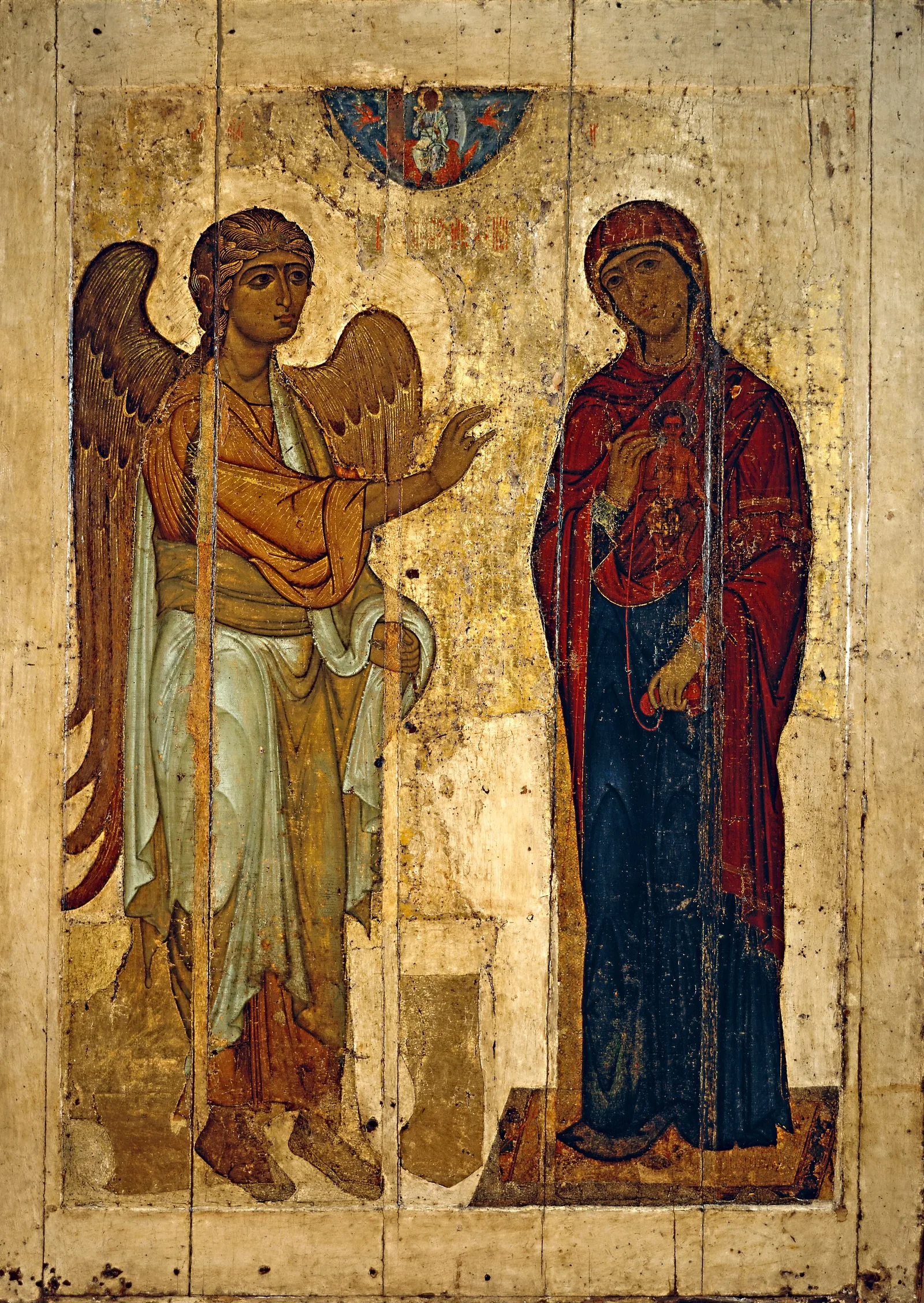
The Ustyug Annunciation. This tall standing Annunciation is also in the Tretyakov Gallery. Its name comes from a legend linking it to St Procopius of Ustyug. Many scholars attribute it to a Novgorod workshop of the mid-twelfth century, though not all agree. It has an unusual detail: the Christ Child is shown faintly within the Virgin's body, an image of the Incarnation at the very moment of the Annunciation.
The Angel with Golden Hair. This archangel's head, probably from a Deesis tier, is in the State Russian Museum in St Petersburg. It is sometimes grouped with the Novgorod panels, but scholars have also proposed Kiev or Vladimir. The thin gold lines (assist) in the hair and the soft modelling of the face are some of the finest work of the period.
Iconographic features
The panels share a recognisable language, inherited from the art of the Comnenian period in Constantinople:
- Monumental scale. Many are large and were made to be seen from a distance in a church, not held close in a home.
- Frontality and symmetry. Faces look straight at the viewer, and their geometry is calm and almost architectural.
- Gold as light. Plain gold grounds place the figures outside earthly space. Gold assist marks the clothing of angels and of Christ.
- Restrained colour. The palette is built on ochres, cinnabar red and deep greens. Faces are modelled from dark sankir underlayers to light highlights.
- Large, expressive eyes. This feature reflects the Byzantine idea that the icon gazes back at the person praying.
Compared with later Novgorod work of the fourteenth and fifteenth centuries, these icons are less linear and less bright in colour. The local school's familiar features came later: strong red grounds, crisp silhouettes and popular saints such as Florus and Laurus, Paraskeva Pyatnitsa and Elijah. The twelfth-century panels are closer to Constantinople. In some cases they may have been painted by Greek masters, or by local painters trained by them.
Murals as context
The panel icons should be seen alongside the city's wall painting. The Church of the Saviour on Nereditsa, built in 1198 and painted, by most accounts, around 1199, held one of the most complete fresco ensembles in Rus'. It was badly damaged during the Second World War and has since been partly restored. Fragments in St Sophia and the Church of St George at Staraya Ladoga show similar features: elongated figures, large eyes and a severe, ascetic mood.
Where the works are today
None of the twelfth-century panels is still in its original church. Most were moved to Moscow over the centuries, some as early as the sixteenth century under Ivan IV. Twentieth-century restoration took them into state collections. Today the main works are in the State Tretyakov Gallery (Holy Face, Ustyug Annunciation), the Moscow Kremlin Museums (St George) and the State Russian Museum (Angel with Golden Hair). The Novgorod State United Museum-Reserve keeps related material, and the city's historic monuments are protected as a UNESCO World Heritage Site.
Part II of this series will turn to the Novgorod icons of the thirteenth century and the emergence of the local school.